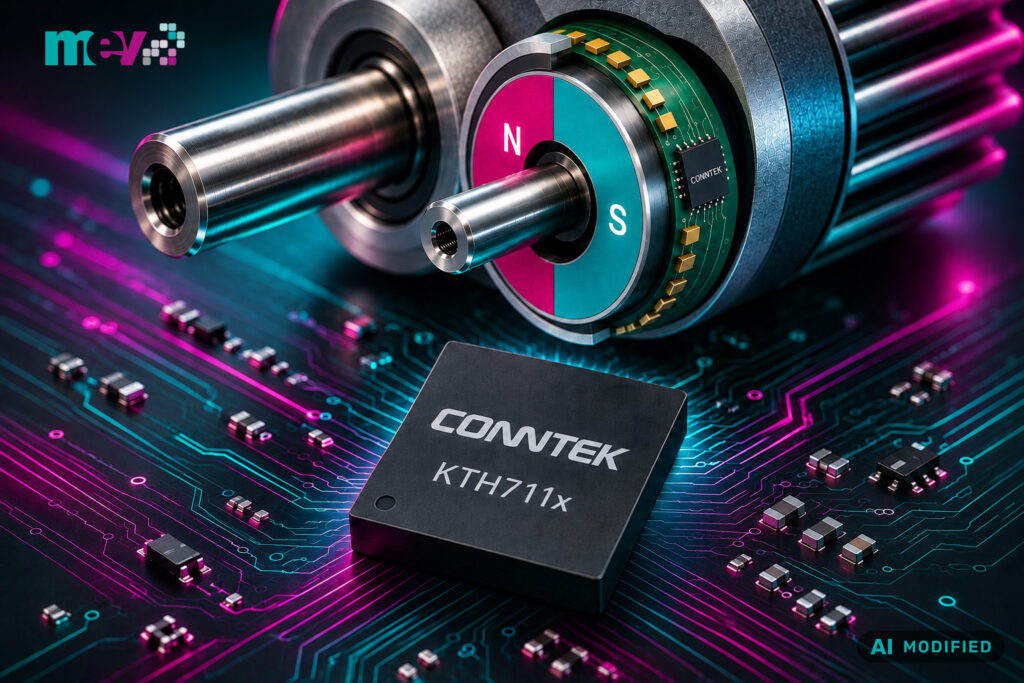
The demands placed on modern motion control systems continue to increase. Higher dynamics, more precise control, and the need to reduce system costs mean that sensor solutions must not only deliver high performance but also be easy to integrate. Angle measurement plays a key role in control quality, efficiency, and robustness, particularly in BLDC and servo drives, robotic axes, and compact mechatronic systems. At the same time, the market is clearly moving toward more highly integrated sensor architectures that perform calibration and compensation directly within the device. This can significantly reduce development effort, software complexity, and production costs.
This is precisely where Conntek’s KTH711x family of magnetic Hall-effect angle encoder ICs comes in. The family is based on a highly integrated 16-bit Hall sensor architecture featuring automatic nonlinear calibration (ANLC), which goes far beyond conventional offset and gain correction. In addition to compensating for static errors, nonlinear magnetic field distortions are systematically detected and corrected internally. This produces a significantly more stable and accurate angle signal while reducing the need for software corrections and production calibration. In practice, the achievable accuracy of magnetic angle measurement systems is often influenced more by mechanical tolerances than by the sensor itself. Even small deviations in magnet positioning, eccentricity, tilt, or magnetic inhomogeneities can significantly degrade measurement linearity. With many conventional solutions, these errors must be compensated for through elaborate mechanical alignment or additional calibration algorithms in the microcontroller.
ANLC technology moves this task directly into the sensor IC. While conventional calibration methods usually correct only offset and gain errors, ANLC also detects and internally compensates for nonlinear components of the magnetic field. This enables very high accuracy even with larger mechanical tolerances.
ANLC calibration is performed directly in the fully assembled sensor system. The calibration function is initiated either via SPI or through the AUTO_CAL input, after which the magnet is rotated at a constant speed between 100 and 1,000 rpm. The device automatically captures magnetic field nonlinearities at multiple measurement points, calculates the required correction parameters, and stores them autonomously in its integrated MTP memory. Because calibration can be restarted at any time, it can be repeated as often as required, for example following changes to the mechanics or magnet, or for optimization during development.
This offers developers several advantages: requirements for the mechanical precision of the magnet and sensor are reduced, the software workload in the microcontroller decreases, and additional calibration steps during production can be eliminated or greatly simplified. This shortens development times, lowers system costs, and enables consistently high measurement quality throughout the application’s service life.
Compared with conventional magnetic angle encoder ICs with basic integrated calibration, which typically exhibit linearity errors of approximately ±0.5° to ±1.0°, and more advanced solutions with internal offset and gain correction in the range of approximately ±0.3° to ±0.5°, the KTH711x family devices occupy a significantly higher precision class.
Thanks to its fully integrated ANLC architecture, which systematically compensates not only for offset and gain errors but also for nonlinear magnetic field distortions, the KTH7112 achieves linearity of up to ±0.1° in on-axis operation.
In off-axis operation, the geometry inherently produces substantially greater magnetic field inhomogeneities and therefore larger linearity errors. Conventional solutions often compensate for these errors only partially, with typical deviations ranging from approximately ±0.6° to ±1.5°. By contrast, the KTH7111 achieves significantly improved linearity of up to ±0.2° through ANLC-based multipoint correction, setting a new benchmark for accuracy in this class of off-axis sensors.
This shifts the approach from correcting the sensor alone to comprehensive, sensor-internal system linearization, significantly reducing calibration effort at system level while substantially improving achievable measurement quality in both on-axis and off-axis configurations.
The KTH7114 extends the benefits of ANLC technology with integrated magnetic stray-field compensation for on-axis applications. This makes the device particularly suitable for environments with high levels of magnetic interference, such as close to motor windings, power electronics, or current-carrying conductors.
The additional compensation of external magnetic fields increases the robustness of angle measurement and enables operation where conventional magnetic sensor systems reach their limits. Developers benefit from greater design freedom and improved operational reliability under real-world conditions.
The high measurement accuracy is complemented by extremely low output noise of just 0.015° rms, an ABZ incremental output with up to 16,384 positions per revolution, and ultra-low latency of only 1 µs. These characteristics make the devices particularly suitable for highly dynamic control and servo applications.
The KTH711x family of ICs features integrated programmable MTP (multi-time programmable) memory, allowing flexible configuration of parameters directly within the device.
Another major advantage is the extremely compact 3 × 3 mm QFN-16L package, making the devices ideal for space-constrained applications and highly integrated system designs.
The KTH7111, KTH7112, and KTH7114 angle sensor ICs offer identical, versatile interfaces, enabling flexible integration into a wide range of systems. The SPI interface allows angle information to be transferred quickly and with low latency to microcontrollers or high-performance controllers—ideal for dynamic applications such as motor control, robotics, and positioning systems.
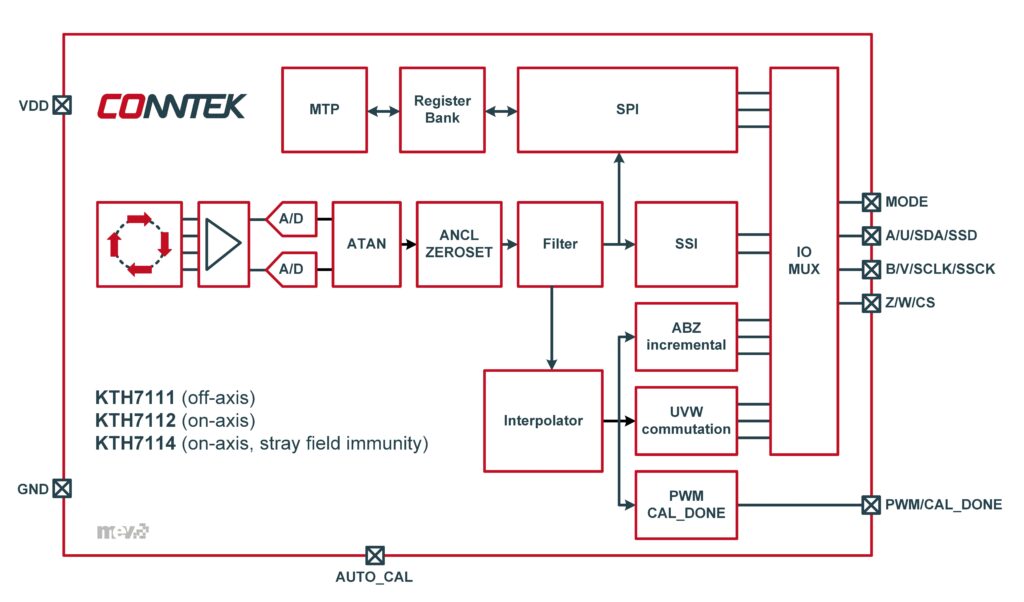
An SSI interface is also available for industrial applications, providing robust and interference-resistant digital transmission. The ABZ and UVW outputs allow the sensors to perform conventional encoder functions directly or to be used for rotor position detection and commutation of BLDC and PMSM motors. A PWM output also provides a straightforward means of integration into systems with simple signal processing.
Another key advantage of these devices is their economic appeal. Despite their high level of integration and performance, the KTH711x family is designed to be extremely cost-effective, offering a remarkably competitive alternative in the market for high-resolution Hall-based magnetic angle encoders.
A variant with AEC-Q100 qualification for automotive applications is currently in preparation and is expected during 2026.
“With the KTH7111, KTH7112, and KTH7114, we see a new generation of magnetic angle encoder ICs that combines precision, integration, and cost efficiency in a way not previously achieved, opening up new design possibilities for our customers,” says Guido Gandolfo, Product Line Manager Motion Control at MEV Elektronik Service GmbH.
MEV Elektronik Service GmbH is a specialist distributor of electronic components and system solutions, focusing on industrial applications, new energy, medical technology, household appliances, and communications solutions. In addition to motion control and sensors, its portfolio includes other areas of expertise such as power electronics, displays, wireless and networking technologies, and memory.
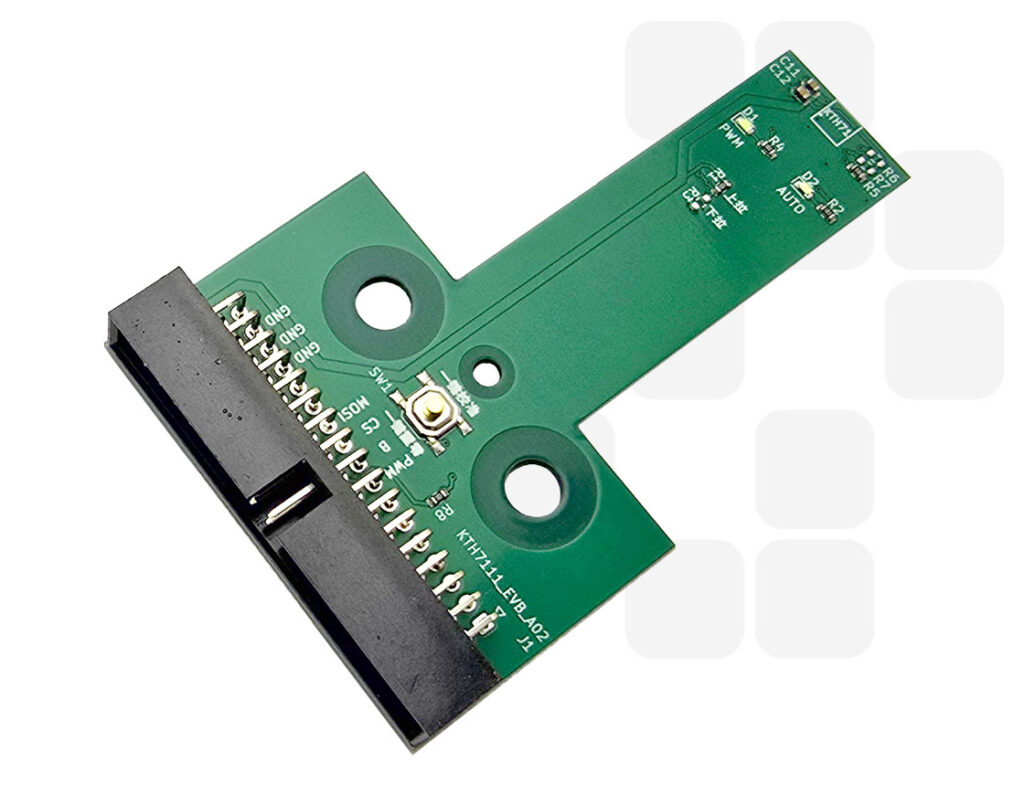
MEV supports customers from the earliest stages of development with comprehensive evaluation options. A team of field application engineers (FAEs) also assist with technical questions. Samples and evaluation kits are available for the KTH711x family to enable fast, practical validation of integration into existing systems. This allows applications to be tested and optimized at an early stage before moving into series development.
MEV will present Fortior’s new FOC-ICs at SPS 2026 in Nuremberg from November 24 to 26. Hall 4, Booth 174. You are welcome to schedule an appointment and request your free ticket in advance!

Conntek (a brand of KTsense Microelectronics, Quanzhou, China) develops high-performance magnetic position sensors and encoder ICs for industrial and automotive applications. By combining advanced analog front-end design with digital signal processing and innovative calibration algorithms, Conntek provides precise, reliable, and easy-to-integrate magnetic sensing solutions for modern motion control systems.
Guido Gandolfo
Product Line Manager
Motion Control
+49 5424 2340-57
ggandolfo@mev-elektronik.com


