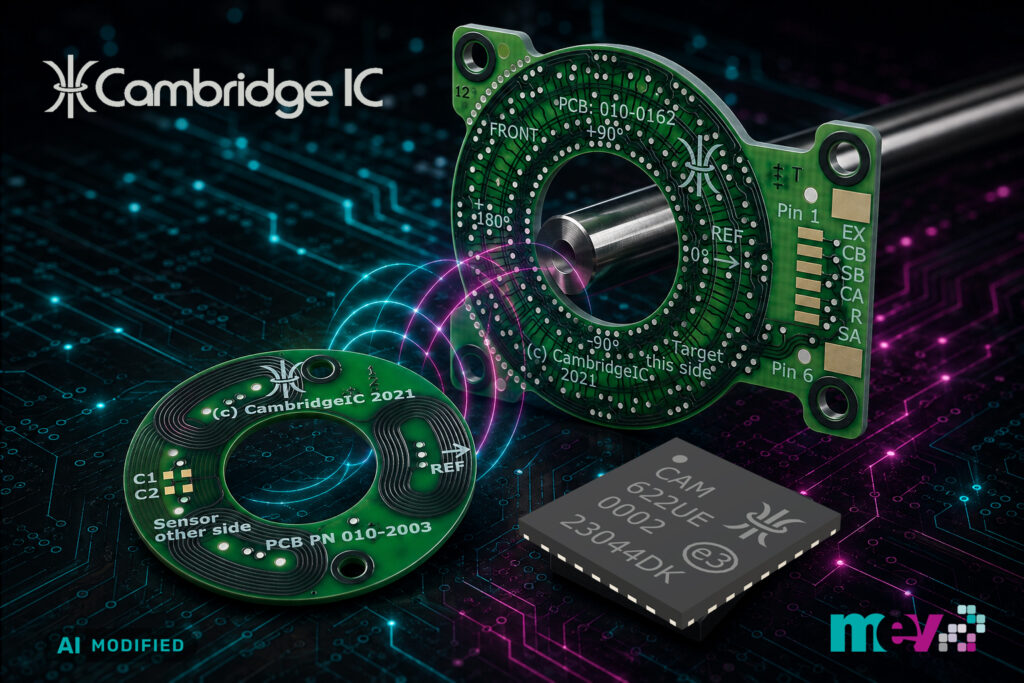
Resonant inductive position sensing has evolved into a powerful alternative to optical and magnetic encoders in recent years. With the CAM622 encoder IC, CambridgeIC provides developers with a highly integrated solution that, particularly in combination with Type-B sensors and targets, sets new standards in terms of robustness, precision and ease of integration.
Contactless position measurement is based on a surprisingly simple principle. Both the sensor and the moving target are manufactured using conventional PCB technology. While the sensor contains several printed coils, the target incorporates a resonant circuit consisting of a PCB coil and capacitors. There is neither mechanical nor electrical contact between the two. Instead, the CAM622 inductively excites the resonator in the target and evaluates the signals coupled back from the target. From their amplitudes, the encoder IC calculates the absolute position of the target.
Unlike optical encoders, no light sources or code discs are required. Permanent magnets, as used in magnetic sensing systems, are also unnecessary. Since both sensor and target consist entirely of PCB structures, they can be manufactured cost-effectively, are mechanically robust and can be integrated directly into existing PCBs or assemblies. The high precision of modern PCB manufacturing translates directly into the measurement accuracy of the sensor.
A key advantage lies in the resonance principle. While conventional inductive position sensors merely evaluate the attenuation or distortion of the magnetic field caused by a target, the target in the Type-B system forms a tuned LC resonator. When excited by the sensor, it stores energy and emits a resonance-enhanced signal. This produces a significantly stronger and more readily evaluated signal, enabling high resolutions, larger air gaps and robust position measurement.
The target’s resonant frequency is continuously monitored. The system automatically adjusts its excitation frequency to the resonant frequency of the connected target, ensuring operation at the optimum operating point at all times. The system is highly immune to temperature change by design, requiring absolutely no compensation.
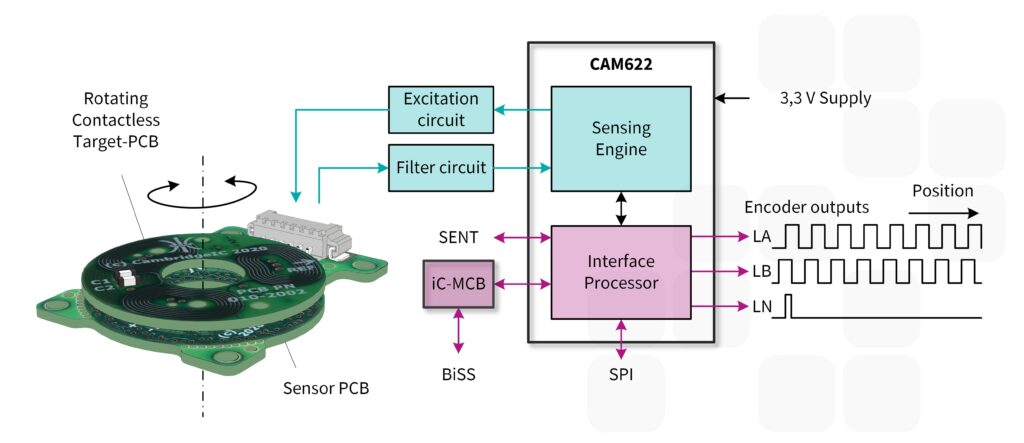
At the heart of the Type-B technology is the CAM622 encoder IC. It processes the signals supplied by the sensor and calculates the absolute position of the target in real time.
Position data can be output via a range of industrial and automotive interfaces. In addition to SPI, the CAM622 supports conventional ABN incremental signals as well as SENT, which is widely used in automotive applications. For applications requiring the BiSS-C interface commonly used in industrial automation, the iC-MCB from iC-Haus provides a suitable interface IC. This allows the CAM622 to be flexibly integrated into a wide variety of control and encoder architectures.
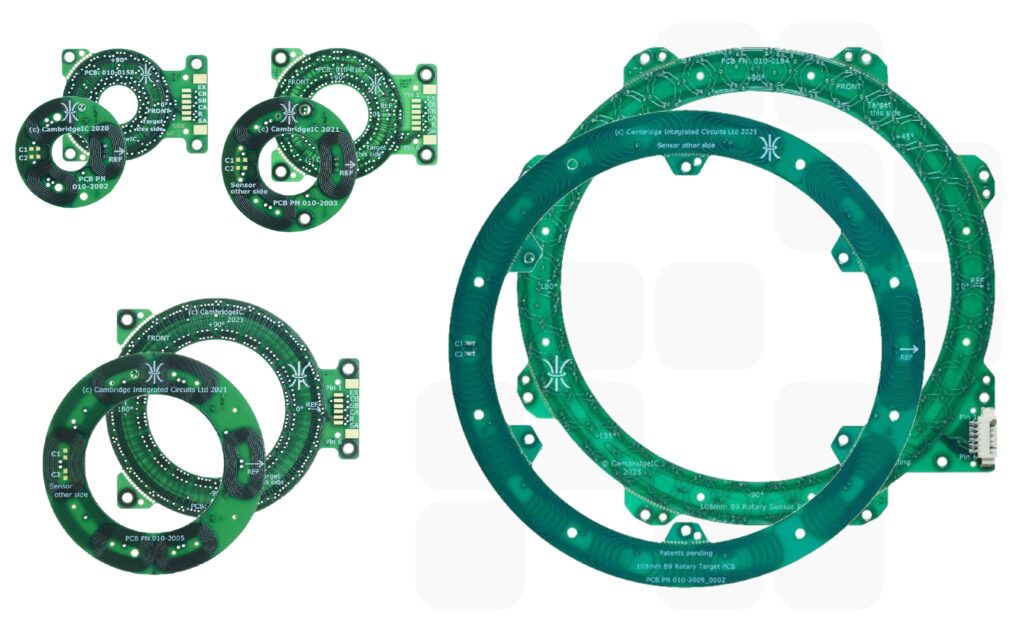
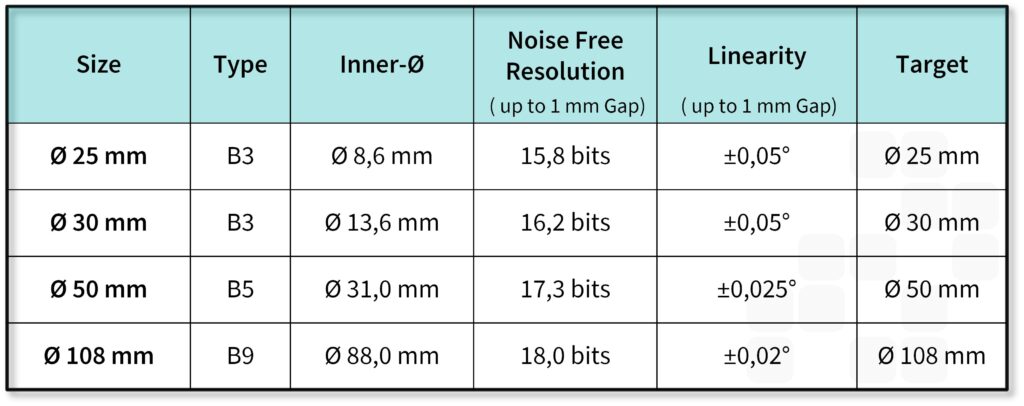
Type-B rotary sensors consist of two PCBs: a stationary sensor PCB and a rotating target. Both feature a central through-hole, allowing them to be mounted directly on a shaft. Only a defined air gap is required between sensor and target. For optimum performance, a gap of up to 1 mm is recommended. However, the measurement principle also operates with significantly larger air gaps, providing a high degree of mechanical design freedom. No mechanical or electrical connection between the two PCBs is required. This allows the sensors to be easily integrated into existing designs and enables contactless absolute angular measurement over 360°.
Measurement performance is largely determined by the design of the sensor structure. The sensor’s Subtype designation indicates the number of high-resolution fine coils.. A B3 sensor has three fine coils, a B5 has five and a B9 has nine. Since all rotary sensors cover a 360° measurement range, the achievable angular resolution increases with the number of fine coils. However, the respective sensor geometry limits the maximum number of fine coils that can be implemented, as they cannot be made arbitrarily small.
Typical applications include standard encoders, servo drives, pan-and-tilt systems for cameras or LiDAR sensors, as well as high-precision angular measurement systems for machinery and industrial equipment.
The resonant inductive measurement principle is equally suitable for contactless linear position measurement. Here, the resonant target moves along a stationary sensor PCB and provides absolute position values across the entire measurement range.
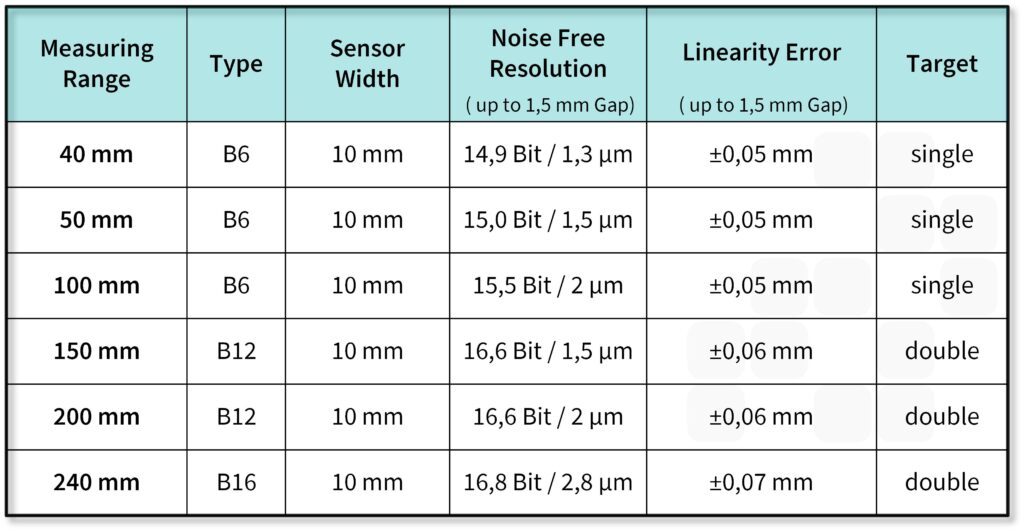
Standard linear sensors type B are available with fixed measurement ranges from 40 mm to 240 mm. For special applications, CambridgeIC can also develop custom sensor geometries as required. In addition to the measurement range, parameters such as sensor width can be adapted to the specific application. A wider sensor, for example, also enables larger air gaps between sensor and target.
Typical applications range from linear motors and valve positioning to steering systems and laboratory automation.
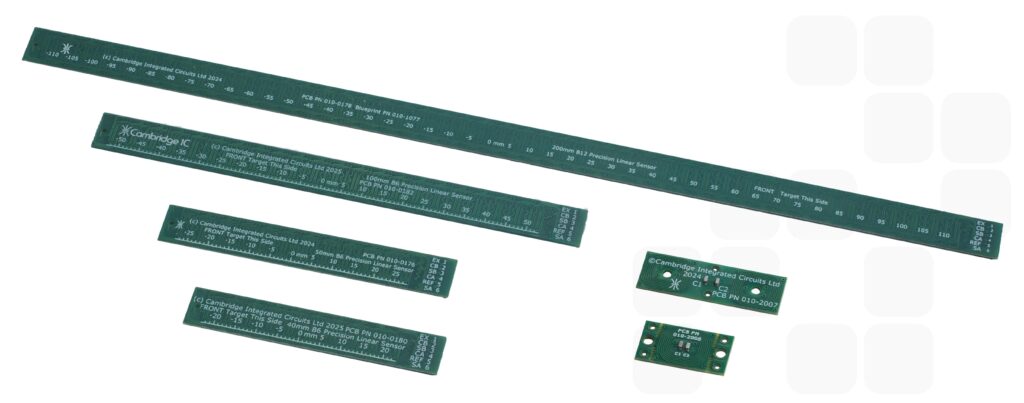
A key advantage of Type-B technology is its straightforward integration into existing electronic systems. CambridgeIC provides developers with the layout data for the sensor and target structures free of charge as Gerber files. Both can therefore be manufactured together with the application’s own PCB by any PCB manufacturer, without additional licence fees. No additional sensor components or special manufacturing processes are required.
This not only reduces material, procurement and assembly costs, but also opens up new mechanical design possibilities. Sensor and target can either be integrated directly into the application’s own PCB or combined with existing assemblies in a space-saving manner.
Thanks to the resonant inductive measurement principle, the system is also tolerant of misalignment and tilt, eliminating the need for mechanical calibration. This simplifies both development and commissioning while also enabling applications where installation space is severely restricted.
For a quick introduction to Type-B technology, a comprehensive evaluation system is available. It consists of the CAM622 MultiComms Board, the MultiComms Adapter as an interface gateway, and Windows software for configuration, visualisation and analysis of measurement data.
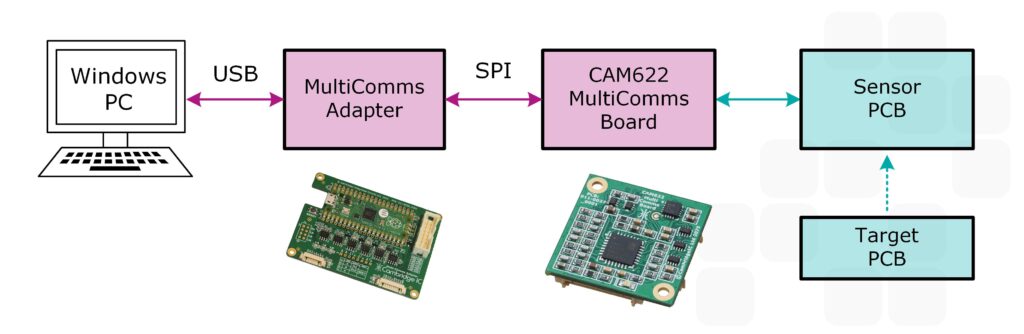
With this evaluation system, developers can immediately start working with the technology without developing their own hardware, characterise different sensors and rapidly validate their applications.
“With the CAM622 and Type-B sensors, our customers have access to a technology that opens up new possibilities in position sensing. The combination of precision, robustness and ease of integration is particularly impressive and enables entirely new design approaches,” explains Guido Gandolfo, Product Line Manager Motion Control at MEV. “I am convinced that this technology offers new possibilities particularly in applications where conventional encoder solutions have previously reached their mechanical design limits.”
In summary, the CAM622 in combination with the Type-B sensor architecture offers an attractive alternative to established encoder technologies for rotary and linear position measurement. The combination of a resonant inductive measurement principle, fully PCB-based sensor technology, intelligent signal processing and straightforward integration gives developers new degrees of freedom when designing modern, cost- and performance-optimised sensor systems.
CambridgeIC is a semiconductor company founded in 2007 and headquartered in Cambridge, UK, specialising in resonant inductive position sensor ICs. The company develops highly integrated single-chip solutions for precise, contactless position and angular measurement in industrial and automotive applications. Its portfolio is complemented by matching sensor and target designs, enabling developers to quickly adopt the technology and implement customised encoder solutions.
CAM622 product page
Rotary Sensors Type B product page
Linear Sensors Type B product page
Guido Gandolfo
Product Line Manager
Motion Control
+49 5424 2340-57
ggandolfo@mev-elektronik.com
The title picture and the text have been modified by AI.